____________________________________________________

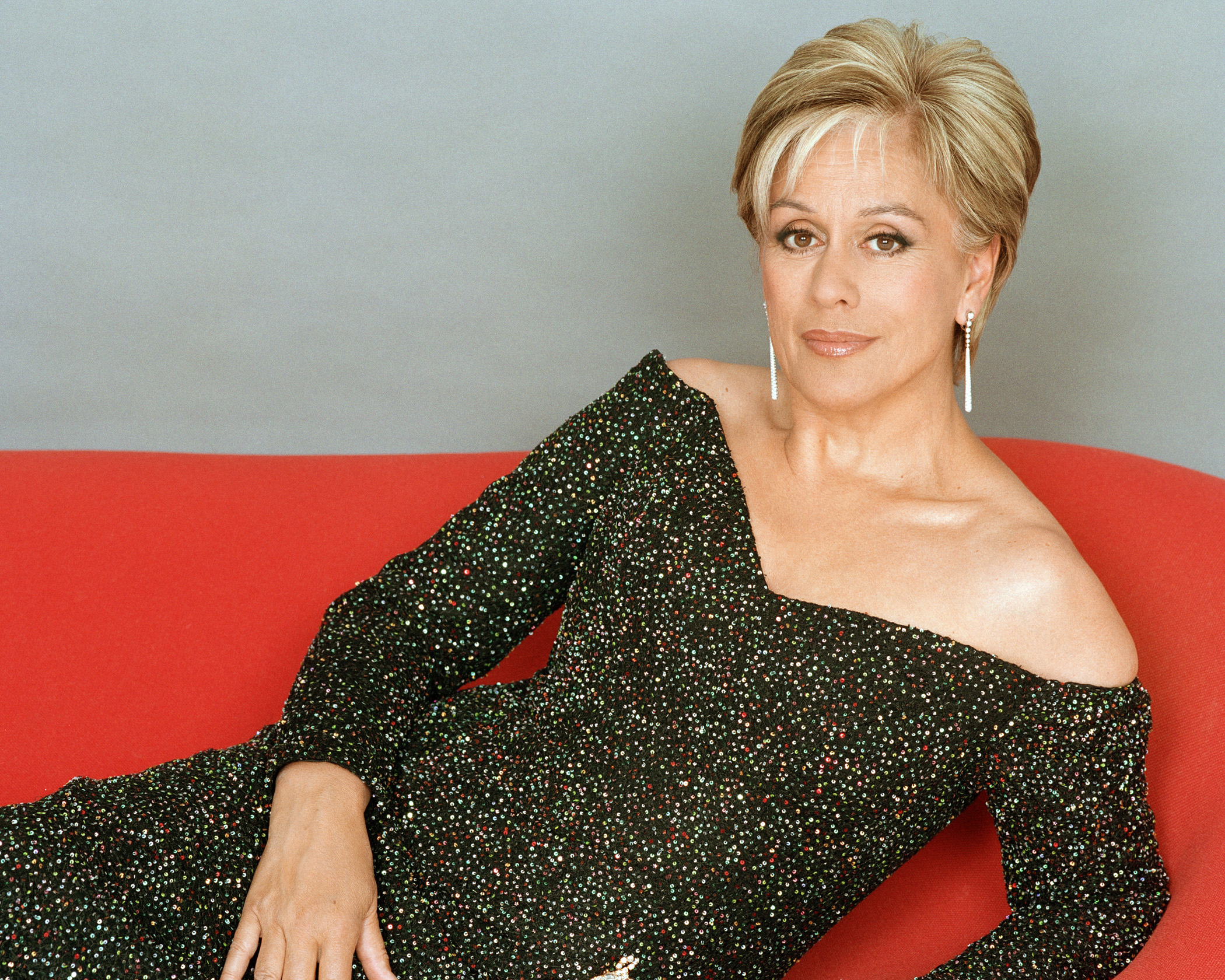
Sir Georg Solti introduced soprano Kiri Te Kanawa to Chicago audiences in May 1978, in Brahms’s Ein deutsches Requiem. Her program biography from those debut performances is here.

The reviews only briefly mentioned the vocal soloists. In the Chicago Tribune: “Miss Te Kanawa and Weikl, both making subscription-series debuts, were a beautifully matched pair of young, fresh-voiced soloists. She seemed a mite cautious at the outset of her solo, but her message of consolation had a billowing purity of sound that was irresistible.” And in the Chicago Sun-Times: “Two soloists are required and both were known to us by reputation, but it was splendid to have singers of the standard of soprano Kiri Te Kanawa and baritone Bernd Weikl on stage to sustain the consistency of achievement in this performance at the highest level.” The complete reviews are here and here.

In addition to the performances at Orchestra Hall, Brahms’s Requiem was also performed at Carnegie Hall on May 12, 1978.

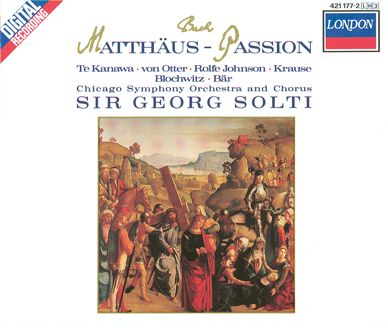
Te Kanawa also appeared with Solti at Orchestra Hall in Duparc’s Melodies Francaises and Mahler’s Fourth Symphony on March 23, 24, 25, and 26, 1983; in Bach’s Saint Matthew Passion on March 19 and 21, 1987; in excerpts from Verdi’s Otello (with Plácido Domingo) on a special concert celebrating Solti’s seventy-fifth birthday on October 9, 1987; and in complete performances of Otello in 1991 at Orchestra Hall (April 8 and 12) and Carnegie Hall (April 16 and 19).

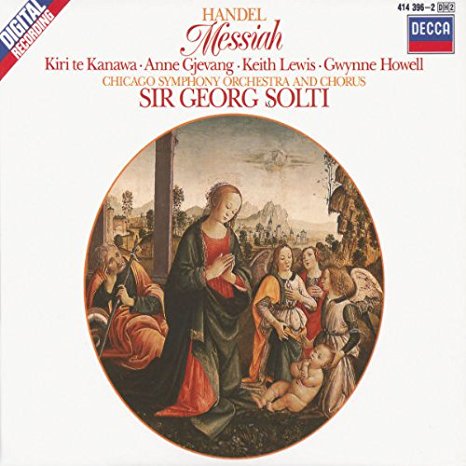
Solti and Te Kanawa made a number of recordings together. With the Chicago Symphony Orchestra, they collaborated on Brahms’s Ein deutsches Requiem in 1978, Mahler’s Fourth Symphony in 1983, Handel’s Messiah in 1984, Bach’s Saint Mathew Passion in 1987, and Verdi’s Otello in 1991.

Te Kanawa also recorded under Solti’s baton in Bizet’s Carmen in 1975 with the London Philharmonic Orchestra and the National Philharmonic Orchestra, Mozart’s Le nozze di Figaro in 1981 with the London Philharmonic Orchestra, Puccini’s Tosca in 1984 with the National Philharmonic Orchestra, and in Verdi’s Simon Boccanegra in 1988 with The Royal Opera (for video). (All recordings were released by London Records.)

In 1990, Solti and Te Kanawa collaborated on a special video project, entitled The Maestro and the Diva, directed by Humphrey Burton. The program candidly showed the two of them in rehearsal (in Solti’s home studio in London) and performance of Richard Strauss’s Four Last Songs with the Vienna Philharmonic. An audio recording was also released and also included several more Strauss songs with Solti at the piano.

Several additional excerpts from the program are also available here.

The attached YouTube video is not the property of the Chicago Symphony Orchestra Association. We just thought it was interesting.

____________________________________________________

Even though she debuted with the Chicago Symphony Orchestra at the Ravinia Festival in August 1972 (in Sibelius’s Violin Concerto with Hans Schmidt-Isserstedt conducting), Korean violinist Kyung-Wha Chung was introduced to downtown Chicago audiences in January 1974 by Sir Georg Solti, performing Mendelssohn’s Violin Concerto. Her program book biography is here.

From the Chicago Tribune: “Few soloists of any age can match Georg Solti in drive and energy output, but last night it took only a measure or two of the Mendelssohn Violin Concerto to certify Kyung-Wha Chung as one of them. The comely Korean violinist still in her mid-twenties, took those familiar old melodies and made them sing as if their life depended on it—as indeed it does. There are more accurate players in the thinning ranks of true virtuoso performers, but only a handful with her ability to sustain listener interest and communicate the feeling behind the notes. . . . Miss Chung takes fullest advantage of her instrument’s ability to breathe life into a sustained tone and has an actress’ sense of phrase and pacing. . . . It has been years since I attended a performance of this work which seemed too short. She left me wishing for more.” The complete reviews are here, here, and here.

With Solti and the CSO at Orchestra Hall, Chung again appeared in Mendelssohn’s Violin Concerto on October 23, 24, 26, and 27, 1979; in Berg’s Violin Concerto and Bartók’s First Violin Concerto on October 13, 14, and 15, 1983; and Bartók’s Second Violin Concerto on October 5, 6, and 7, 1995. Out of town, she performed with Solti and the Orchestra in Mendelssohn’s Violin Concerto on January 21, 1974, in Milwaukee.

Chung recorded with Solti on several occasions. With the Chicago Symphony Orchestra, in 1979 she recorded Mendelssohn’s Violin Concerto for video, and in 1983 she recorded Bartók’s First Violin Concerto and Berg’s Violin Concerto. With the London Philharmonic Orchestra, in 1976 she recorded Bartók’s Second Violin Concerto and in 1977 she recorded the Elgar Violin Concerto. All recordings were released by London Records.

____________________________________________________

Just after winning the Avery Fisher Prize (an award he shared with Lynn Harrell), twenty-seven-year-old Murray Perahia made his debut with the Chicago Symphony Orchestra in January 1975 under the baton of Sir Georg Solti, performing Mendelssohn’s Second Piano Concerto. His program book biography is here.

In the Chicago Sun-Times, Perahia was praised for his “bravura in the most generous measure . . . perfectly suited to this repertory. . . . [he] has all the flair for color and phrasing, all the skill in nuance and expression needed to make a Mendelssohn concerto sound worthy of Mozart. It was a gracious, lyric performance for all its energy, and a very exciting debut.” And in the Chicago Tribune, “Perahia is no ordinary pianist. At 27, he has considerably more behind him than the customary string of awards. . . . [He is] an immensely talented musician who seemingly had everything.” The complete reviews are here, here, and here.

With Solti and the CSO at Orchestra Hall, Perahia also appeared in Mozart’s Piano Concerto no. 20 on April 21, 22, and 23, 1977; in Beethoven’s First Piano Concerto on November 30, December 1, and 2, 1978; in Mendelssohn’s First Piano Concerto on October 9, 10, and 11, 1980; in Schumann’s Piano Concerto on September 24, 25, and 26, 1987; and in Mozart’s Piano Concerto no. 24 on March 14, 15, and 18, 1997.

Out of town, he performed with Solti and the Orchestra in Mozart’s Piano Concerto no. 20 on April 20 at the University of Chicago and April 25, 1977, in Milwaukee; and in Mendelssohn’s First Piano Concerto on October 13, 1980, also in Milwaukee.

Perahia also appeared on a special concert at Orchestra Hall celebrating Sir Georg’s seventy-fifth birthday on October 9, 1987, in Mozart’s Concerto for Two Pianos in E-flat major with the maestro conducting from the keyboard.

He also recorded with Solti on two occasions: in 1982 performing Brahms’s Variations on a Theme by Haydn for Two Pianos, and in 1987 performing Bartók’s Sonata for Two Pianos and Percussion (with Evelyn Glennie and David Corkhill). Both recordings were for CBS Records.

____________________________________________________

At Sir Georg Solti’s invitation, Swedish mezzo-soprano Anne Sofie von Otter made her U.S. debut with the Chicago Symphony Orchestra in October 1985, in Mozart’s Mass in C minor. Her biography from the program book is here. Reviews of the performance (here and here) mentioned her “clear, agile, flexible, and unhooty [!] mezzo-soprano” and her “big, warm voice which she uses with consistent intelligence and fine musical intuitions.”

In 1989 when von Otter made her debut at Lyric Opera of Chicago (as Octavian in Strauss’s Der Rosenkavalier), a feature article in the Chicago Tribune mentioned Solti introducing her to Chicago audiences. She remarked: “I admire Solti immensely . . . He has this incredibly contagious enthusiasm for the music and he fills you with the will to work. Maybe it’s his age and experience, but I respect him more than any other conductor I have worked with.”

With Solti and the CSO at Orchestra Hall, von Otter also appeared in Bach’s Saint Matthew Passion on March 19 and 21, 1987; in Berlioz’s The Damnation of Faust on May 18, 19, and 20, 1989; and Bach’s Mass in B minor on January 25, 26, and 28, 1990. (Both Bach works were recorded for London Records.)

She also appeared on tour in 1989 in Berlioz’s The Damnation of Faust on August 28 at the Royal Albert Hall in London and on August 30 at the Grosses Festspielhaus in Salzburg; and again in 1996 in Beethoven’s Ninth Symphony on September 13 at the Royal Albert Hall. (The London performance of the Berlioz was also released by London Records on video.)

With Solti, von Otter also recorded Mozart’s Mass in C minor in December 1990 with the Vienna Philharmonic and Mozart’s Così fan tutte (as Dorabella) in May 1994 with the Chamber Orchestra of Europe (both for London Records).

____________________________________________________

Sir Georg Solti introduced a number of up-and-coming artists to Chicago audiences, including seventeen-year-old Anne-Sophie Mutter in October 1980. She was a replacement for the originally scheduled Leonid Kogan.

According to her biography in the program book, Mutter had made her U.S. debut with Zubin Mehta and the New York Philharmonic in January 1980, performing Mendelssohn’s Violin Concerto. Two weeks later, she appeared with the National Symphony Orchestra in Mozart’s Third Violin Concerto with Mstislav Rostropovich conducting.

For her Chicago Symphony Orchestra debut, Mutter performed Beethoven’s Romance in G major and Mozart’s Third Violin Concerto. Reviews of the performances, concentrating primarily on Sir Georg’s account of Bruckner’s Fourth Symphony, are here, here, here, and here.

Mutter appeared twice more with the CSO under Solti’s baton: on January 12 (special University Night concert), 13, 14, and 15, 1983, in Mozart’s Fourth Violin Concerto; and on May 11, 12, and 13, 1989, in Beethoven’s Violin Concerto.

____________________________________________________

On January 29, 30, and 31, 1976, Sir Georg Solti conducted the Chicago Symphony Orchestra and Chorus’s first performances of Roger Sessions‘s When Lilacs Last in the Dooryard Bloom’d. The work had been chosen as part of the CSO’s recognition of the U.S. Bicentennial celebrations.

According to Arrand Parsons’s program note, in Walt Whitman‘s poem, three symbols appear: “the ‘great star,’ representing the assassinated Lincoln; the lilac, which usually is interpreted as human love; the thrush, representing the soul which has as its song the carol of death, a carol Whitman accepts as his own when he says ‘the voice of my spirit tallied the song of the bird.’ Sessions has arranged the score into three continuous parts. The first part sets the mournful mood and presents the symbolic elements: the ‘powerful western fallen star,’ the lilacs, and the song of the thrush. In the second part, the poet describes Lincoln’s funeral train slowly moving from Washington to Springfield, and his burial. The poet describes the land and its people, and a central and high point is the alto solo in which the ‘carol of the bird’ reflects on death. At the end, the symbols are united.”

The composer also contributed to the program note: “My cantata When Lilacs Last in the Dooryard Bloom’d was composed principally between 1967 and 1969; the orchestral score was finished in the autumn of 1970. The work was commissioned by the Committee for Arts and lectures of the University of California at Berkeley, in celebration of the University’s centennial in 1968; but it also represents, for me, the fruition of an idea that had been in my mind for very many years. Even during my adolescent years—the period of the First World War—the poem, written under the spell of one of the most tragic moments of our history, with its moving evocation of the rich American landscape in spring, with its lilacs, its forests, and its thrushes, and of the Civil War, had touched me very deeply; and in 1921 I even made a number of musical sketches for a possible musical setting of it. I was not satisfied with these sketches, however, and concluded that I was not ready at that time to undertake such a work. I never forgot it, however, and when the proposal was made that I write a work involving chorus and possible solo voice, it became clear to me that the time had come for me to write this work. I have to confess that only after having made many preliminary sketches and having become thoroughly involved in the music did I fully realize what its dimensions must be.

“The dedication to the memory of Dr. Martin Luther King and of Robert Kennedy was, of course, the result of the fact that their political assassinations occurred while I was working on the second part of the cantata.

“I have used as my text Whitman’s poem in its entirety with only occasional brief cuts, which the musical setting as I conceived it seemed to demand. These cuts are mainly in the third section, though to a lesser extent in the second also. They all occur at moments where verbal elaboration or repetition, though very powerful and very characteristic in the text as such, seemed to me redundant in the context of a musical setting.”

For these performances, soprano Sarah Beatty, mezzo-soprano Josephine Veasey, and baritone Dominic Cossa were the soloists; and the Chicago Symphony Chorus was prepared by Margaret Hillis. The second half of the program included the first CSO and CSC performances of Stravinsky’s Oedipus Rex. Reviews of the performances are here and here.

____________________________________________________

Finally.

“My long-delayed debut with the Chicago Symphony took place at Ravinia in August 1954, two years [sic] later than originally planned. In one of the concerts, the violinist Ruggiero Ricci and the cellist Paul Tortelier played the Brahms Double Concerto, but as a result of the intense humidity in the park, Tortelier’s bow slipped during the cello’s opening cadenza. He stopped, shook his head, and kept on repeating, ‘No good, no good,’ until we started again.

“These performances with the Chicago Symphony Orchestra in Ravinia were an absolute joy. I still remember the performance of Beethoven’s ‘Eroica’ Symphony during our first concert—the most wonderful musical experience of my professional life up to that time. The orchestra’s music director was another Hungarian, Fritz Reiner, who, along with George Szell in Cleveland, Antal Dorati in Dallas, and Eugene Ormandy in Philadelphia, was one of the Hungarian conductors who helped build the excellence of today’s modern American orchestras. Even more than the much-feared Szell, Reiner was infamous among orchestra musicians for his dictatorial behavior. But he did marvelous things for the Chicago Symphony. Despite the imperfect acoustical environment of Ravinia at that time, I had no doubt that this was the finest ensemble I had ever conducted.”*

Reviews from the Chicago Tribune of three of the performances are here, here, and here.

August 3, 1954

August 5, 1954

August 7, 1954

August 8, 1954 – Jacob Lateiner was a last-minute replacement for an ailing Alexander Uninsky

*Text excerpted from Memoirs by Sir Georg Solti. Reviews courtesy of Proquest via the Chicago Public Library.

____________________________________________________

“Eventually, I got my U.S. visa, but it came so late that I had to cancel my Ravinia engagement. However, my American debut took place . . . when I conducted the San Francisco Opera. At that time, the opera orchestra drew on players from the San Francisco Symphony, which from 1936 until 1952 had been directed by Pierre Monteux, one of the most brilliant conductors of the first half of the twentieth century. I met him later in Frankfurt, when he conducted one of the museum’s concerts.

“In San Francisco, I was delighted to work with an orchestra that played at a much higher standard than that of Munich or Frankfurt. My repertoire consisted of Elektra, Die Walküre, and Tristan . . . the San Francisco performances went well, and so did the performances that I gave with the orchestra when we went on tour to Los Angeles.”*

The casts:

September 25 and 30, 1953 – War Memorial Opera House, San Francisco
October 20, 1953 – Shrine Auditorium, Los Angeles
STRAUSS Elektra
Klytemnestra Margarete Klose mezzo-soprano (U.S. opera debut)
Aegisthus Ludwig Suthaus tenor (U.S. opera debut)
Elektra Inge Borkh soprano (U.S. opera debut)
Chrysothemis Ellen Faull soprano
Orestes Paul Schöffler baritone
Guardian of Orestes Desire Ligeti bass
The Confidant Eloise Farrell soprano
The Trainbearer Ruth Roehr soprano
A Young Servant Cesare Curzi tenor
An Old Servant Jan Gbur bass
The Overseer of the Servants Yvonne Chauveau soprano
First Maidservant Margaret Roggero contralto
Second Maidservant June Wilkins soprano
Third Maidservant Janice Moudry mezzo-soprano
Fourth Maidservant Lois Hartzell soprano
Fifth Maidservant Beverly Sills soprano
Carlo Piccinato, stage director
Kurt Herbert Adler, chorus director
Harry Horner, set designer
Julius Dobe, set painter

October 2 and 7, 1953 – War Memorial Opera House, San Francisco
October 23, 1953 – Shrine Auditorium, Los Angeles
WAGNER Tristan und Isolde
Tristan Ludwig Suthaus tenor
Isolde Gertrude Grob-Prandl soprano (U.S. opera debut)
Brangäne Margarete Klose mezzo-soprano
King Mark Dezső Ernster bass (October 2 and 23)
King Mark Desire Ligeti bass (October 7)
Kurwenal Paul Schöffler baritone
Melot George Cehanovsky baritone
Shepherd Lawrence Mason tenor
Steersman Jan Gbur bass
A Sailor’s Voice Cesare Curzi tenor
Carlo Piccinato, stage director
Kurt Herbert Adler, chorus director
Armando Agnini, set designer
Julius Dobe, set painter

October 13 and 18, 1953 – War Memorial Opera House, San Francisco
November 1, 1953 – Shrine Auditorium, Los Angeles
WAGNER Die Walküre
Brünnhilde Gertrude Grob-Prandl soprano
Sieglinde Inge Borkh soprano
Fricka Margarete Klose mezzo-soprano
Siegmund Ludwig Suthaus tenor
Wotan Paul Schöffler baritone
Hunding Dezső Ernster bass
Helmwige Ellen Faull soprano
Gerhilde Beverly Sills soprano
Ortlinde Yvonne Chauveau soprano
Siegrune Janice Moudry mezzo-soprano
Rossweisse Margaret Roggero contralto
Waltraute Eloise Farrell soprano
Grimgerde Donna Petersen mezzo-soprano
Schwertleite June Wilkins contralto
Carlo Piccinato, stage director
Armando Agnini, set design
Julius Dobe, set painter

*Text excerpted from Memoirs by Sir Georg Solti. Also, thanks to Kirsten Tanaka (head librarian and archivist at the Performing Arts Library, Museum of Performance & Design) and the San Francisco Opera’s online performance archive.

____________________________________________________

Chicago Sun-Times - July 12, 1953

“In 1953, I made my first visits to the United States. Interestingly enough, given the turn my career eventually took, my North American debut was originally scheduled to take place at the Ravinia Festival . . . with the Chicago Symphony Orchestra. But my U.S. visa application was turned down. The American consul in Frankfurt kindly explained that my visa had been denied because I was listed as belonging to the Soviet Friendship Association, a Communist organization. I couldn’t understand how this could be, as I had never belonged to any political group.

“Fortunately, I knew a Dr. Müller, the Minister of Internal Affairs, and he telephoned the police in Munich to authorize them to show me the document. This document turned out to be a list, prepared by this Communist organization, of prominent non-Communists in cultural life who were to have propaganda material sent to them. With that information in hand, I went back to Frankfurt and explained to the American consul that the list they had seized was not a list of members of the Communist party, but merely a mailing list of people in cultural life. . . . Indeed, in the late 1940s, representatives of the U.S. military government in Bavaria had informed me that if I wanted to maintain my position in Munich, I would have to give up my Hungarian citizenship; by then, Hungary had become a Soviet satellite state. I was not sad about renouncing my original nationality, but being stateless for the next few years presented endless bureaucratic complications. In the end, the West German government kindly offered me German citizenship, which I gratefully accepted, and I remained a German national for nearly twenty years.

“Eventually, I got my U.S. visa, but it came so late that I had to cancel my Ravinia engagement. However, my American debut took place . . . when I conducted the San Francisco Opera.”*

The advance program advertisement in the Ravinia Festival program book during the first week of July 1953

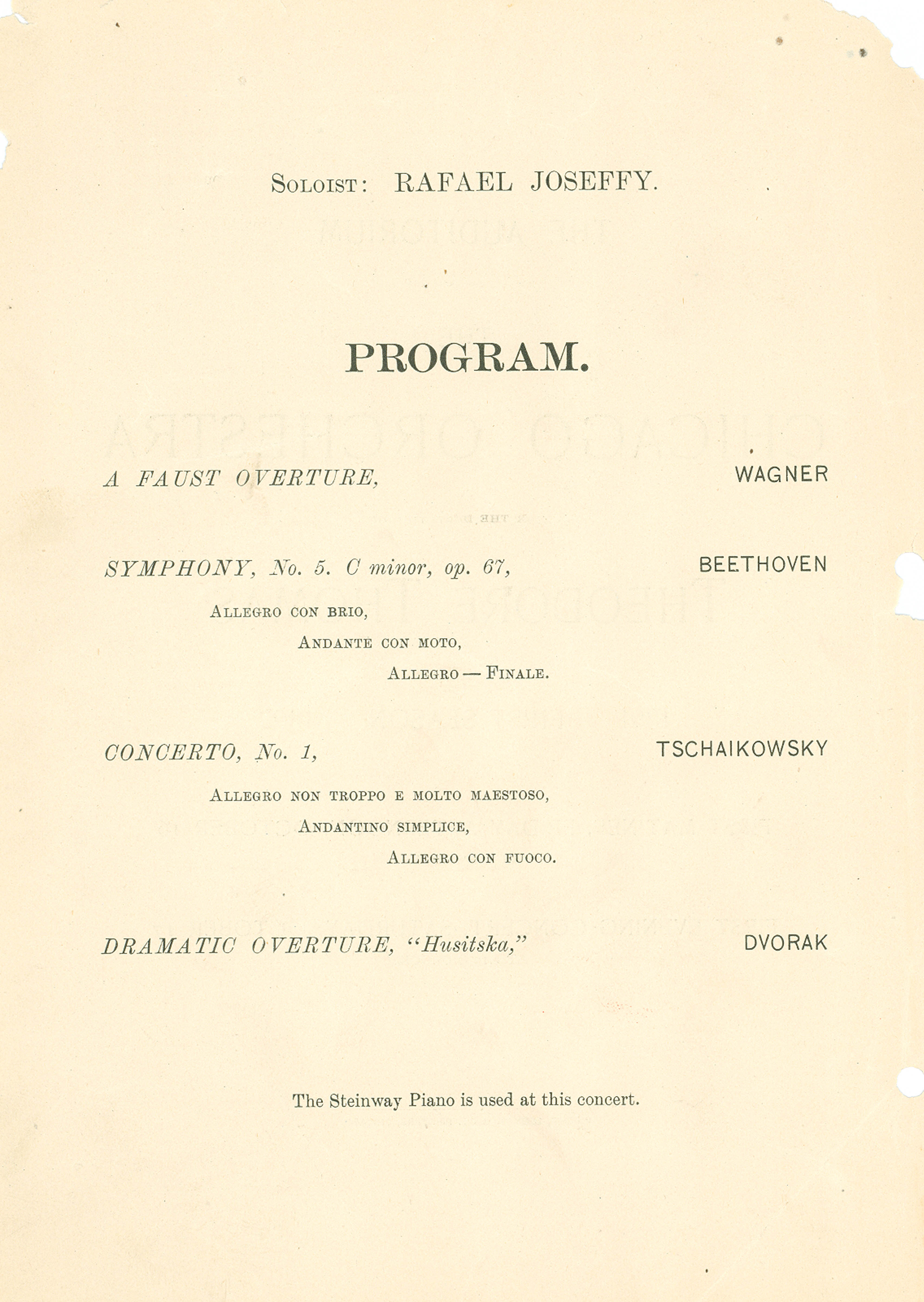
The program that would have been Solti's U.S. debut on July 14, 1953

Programs for that week’s concerts were revised. Otto Klemperer, who had conducted the previous week, stayed over for the July 14 and 16 concerts (ironically, according to the advertisement: “one critic, after Solti’s appearance with the Vienna Philharmonic, called him ‘a young Klemperer’”). Pierre Monteux, scheduled for the following week, arrived early to lead the July 18 and 19 performances.

*Text excerpted from Memoirs by Sir Georg Solti.

____________________________________________________

On October 25, 1973, Sir Georg Solti conducted the world premiere of Bohuslav Martinů’s First Violin Concerto with Josef Suk as soloist.

From Arrand Parsons’s program note: “It is a curious fact that a major work by a major 20th century composer has remained unknown and only in manuscript for over 40 years. (The Martinů Violin Concerto composed for Mischa Elman in 1943 and now known to be No. 2 was performed at CSO concerts on November 16-17, 1944, with Elman as soloist and with Désiré Defauw conducting.) The manuscript comes to the Chicago Symphony Orchestra from the Hans Moldenhauer Archives, today one of the great collections of original manuscripts, a portion of which is held by Northwestern University. It was Dr. Moldenhauer who suggested to Josef Suk the idea of presenting the premiere performances in Chicago, to be followed shortly afterwards with performances in Prague. The Northwestern University Library made the score available to Sir Georg Solti, who was happy to program the premiere with the Chicago Symphony Orchestra. The Concerto, composed for the Polish-born American violinist Samuel Dushkin probably in 1933, comprises three movements. It is a work of commanding virtuosity yet retaining an expressive lyricism characteristic of the composer, and it also reflects certain Czech qualities found in the works of Martinů in the 1930s when he lived in Paris but felt a nostalgia for his homeland.”

Reviews of the premiere are below:

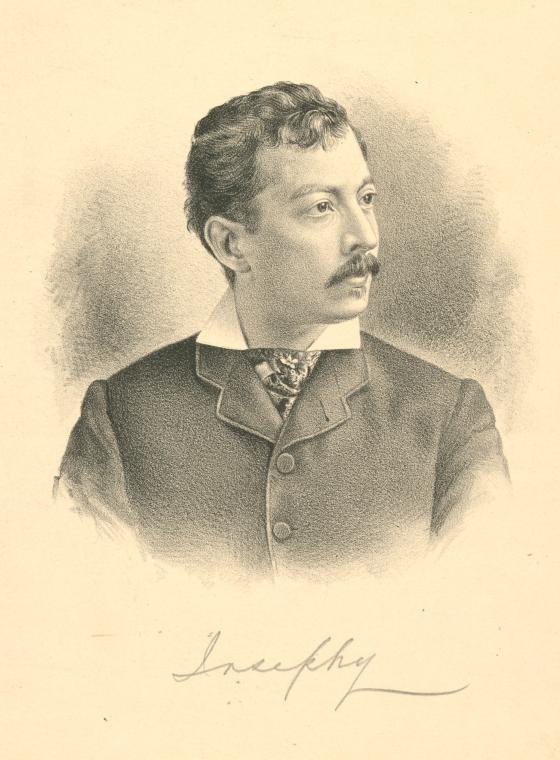
Theodore Thomas

csoarchives twitter feed

  • May 26, 1892: At the Cincinnati May Festival, Theodore Thomas leads the U.S. premiere of Bruckner's Te Deum. #chicagosymphony 2 hours ago
  • May 25, 1893 - William L. Tomlins leads the Orchestra and a chorus of 1,250 voices in Haydn's Creation at the World's Columbian Exposition. 1 day ago
  • May 24, 1924: Frederick Stock leads the U.S. premiere of Respighi's La primavera at the Ann Arbor May Festival. 2 days ago
  • Reiner and the CSO: one of the 2011 inductees to the National Recording Registry! sfgate.com/cgi-bin/articl… 2 days ago

chicagosymphony twitter feed

disclaimer

The opinions expressed here are mine and do not necessarily reflect those of my employer.

visitors

  • 21,420 hits
Follow

Get every new post delivered to your Inbox.